
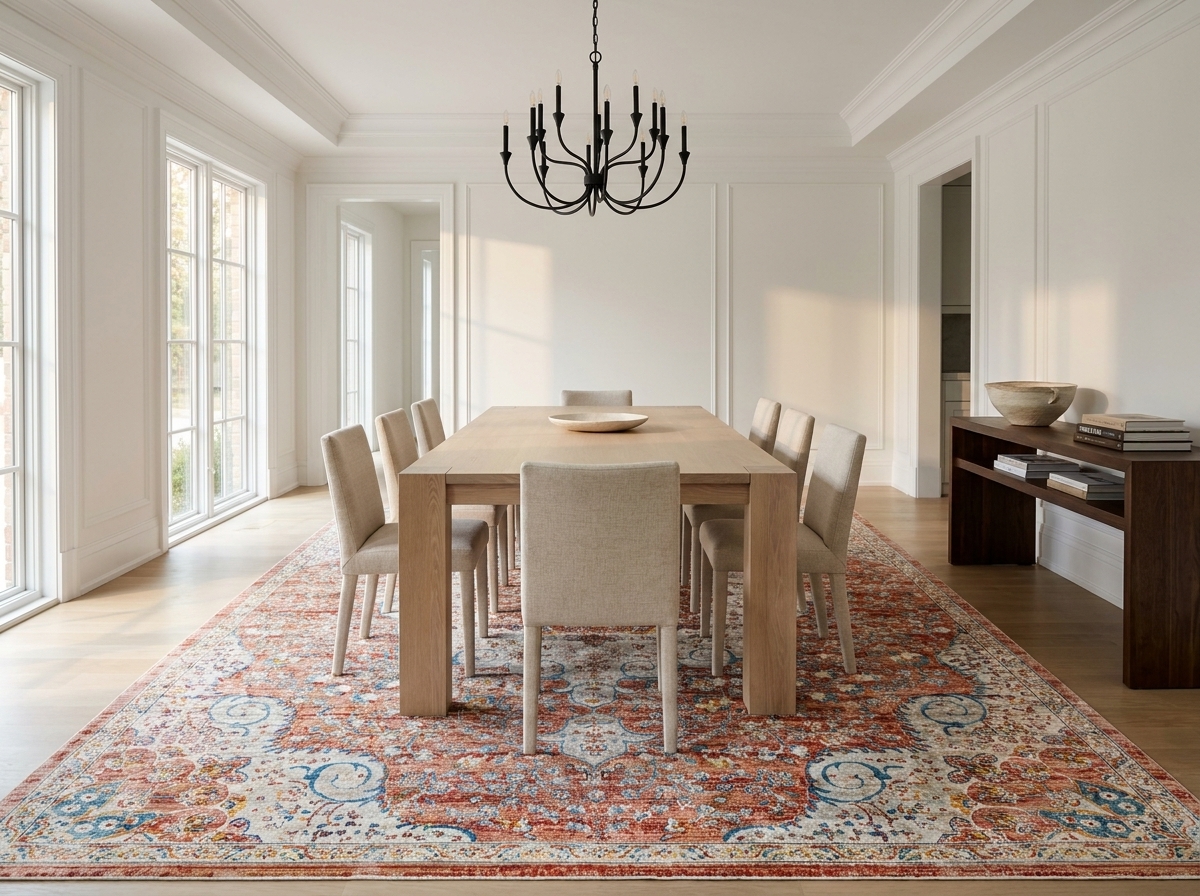
A dining room rug has one of the hardest jobs in your home.
It needs to:
- Look beautiful
- Handle heavy furniture
- Survive spills and crumbs
- Stay comfortable underfoot
- Make the room feel complete
And unlike living room or bedroom rugs, dining room rugs have to perform every time someone pulls out a chair.
That’s why choosing the right dining room rug isn’t just about style – it’s about function.
Here’s everything you need to know before buying a dining room rug.
Do You Really Need a Rug Under a Dining Table?
Not necessarily.
But a well-chosen rug can dramatically improve a dining space.
A dining room rug helps:
- Define the dining area
- Add warmth and texture
- Reduce noise from chairs and dishes
- Protect flooring from scratches
- Make the room feel more finished
In open-concept homes, rugs are especially important because they visually separate the dining area from surrounding spaces.
What Size Rug Should Go Under a Dining Table?
This is the most important dining room rug rule:
The rug should be large enough that chairs remain on the rug even when pulled out.
If guests pull their chairs back and the legs catch on the edge of the rug, the rug is too small.
The 24-Inch Rule
A good rule of thumb:
Leave approximately 24 inches of rug beyond each side of the table.
This allows chairs to slide comfortably without leaving the rug.
Dining Table Rug Size Chart
When in doubt, size up.
A rug that’s too large is usually less noticeable than one that’s too small.
Should the Rug Match the Shape of the Table?
Generally, yes.
Matching shapes creates visual harmony.
Rectangular Table
Best with:
Round Table
Best with:
Square Table
Best with:
This isn’t a strict rule, but it often creates the most balanced look.
What Is the Best Material for a Dining Room Rug?
Dining rooms see a lot of activity, which means durability matters.
The ideal dining room rug should be:
- Easy to clean
- Low maintenance
- Resistant to wear
Low-Pile Rugs (Best Overall)
Low-pile rugs are often the best choice because:
- Chairs slide easily
- Crumbs are easier to vacuum
- Less likely to trap debris
They offer the best combination of style and practicality.
Wool Rugs
Pros:
- Durable
- Naturally stain-resistant
- Long-lasting
Great for formal dining rooms and everyday use.
Synthetic Rugs
Materials like:
Offer:
- Easy cleaning
- Stain resistance
- Budget-friendly durability
Ideal for families and high-use dining spaces.
Should You Use a High-Pile Rug in a Dining Room?
Usually not.
Thick, plush rugs may feel luxurious, but they can cause problems:
- Chairs become difficult to move
- Food gets trapped in fibers
- Cleaning becomes harder
For dining rooms, lower piles almost always perform better.
What Color Rug Works Best in a Dining Room?
Many homeowners worry about spills.
The good news?
The right color and pattern can hide everyday messes surprisingly well.
Best Colors for Dining Rooms
Consider:
- Medium grays
- Warm taupes
- Earth tones
- Multi-color patterns
- Vintage-inspired designs
These colors help disguise:
- Crumbs
- Minor stains
- Everyday wear
Colors That Show Everything
While beautiful, these often require more maintenance:
- Pure white
- Very light cream
- Solid black
- High-gloss synthetic finishes
Patterned vs Solid Rugs in Dining Rooms
If practicality matters, patterned rugs usually win.
Patterned rugs:
- Hide stains better
- Camouflage wear
- Age more gracefully
Solid rugs create a cleaner look but tend to reveal:
- Crumbs
- Spills
- Traffic patterns
For busy households, subtle patterns are often the sweet spot.
Dining Room Rug Mistakes to Avoid
Mistake #1: Choosing a Rug That’s Too Small
The most common mistake.
If chair legs leave the rug when guests sit down, the rug is undersized.
Mistake #2: Using a High-Pile Rug
Beautiful in theory.
Frustrating in practice.
Mistake #3: Ignoring Cleanability
Dining rooms are spill zones.
Choose materials and colors that fit your lifestyle.
Mistake #4: Forgetting About Chair Movement
Every chair should glide smoothly across the rug.
Test this mentally before purchasing.
Do Dining Room Rugs Work in Open Floor Plans?
Absolutely.
In fact, they’re often essential.
A rug helps:
- Define the dining zone
- Separate dining from living spaces
- Create visual structure
Without a rug, furniture can feel like it’s floating in a large room.
How to Choose a Dining Room Rug Based on Your Lifestyle
If You Have Kids
Look for:
- Stain-resistant materials
- Patterned rugs
- Easy-to-clean fibers
If You Entertain Often
Choose:
- Durable wool or synthetic rugs
- Larger sizes
- Timeless designs
If You Want a Formal Dining Room
Consider:
- Wool rugs
- Traditional patterns
- Rich textures
Final Thoughts
A dining room rug is one of the hardest-working pieces in your home.
It has to balance:
- Beauty
- Durability
- Comfort
- Function
The best dining room rug isn’t necessarily the most expensive one.
It’s the one that allows people to gather, move, eat, and enjoy the space comfortably while making the room feel complete.
Quick Dining Room Rug Checklist
Before buying a dining room rug, ask:
✔ Is it large enough for pulled-out chairs?
✔ Is the pile low enough for smooth chair movement?
✔ Can it handle spills and daily use?
✔ Does it define the dining space?
✔ Will it still look good after years of meals and gatherings?
If the answer is yes, you’ve likely found the right dining room rug.
Because the best dining room rugs don’t just sit under the table – they help bring people together around it.
Rugs.com is a one-stop online rug shop for all your floor covering needs. With over 100,000 rug designs, the extensive selection of indoor and outdoor rugs offers a wide variety of shapes, styles, and textures – perfect for every season of the year and season of life. With more than 60 years of experience in hand-knotted and machine-woven rugs, the family-owned and operated business believes that “Beneath Every Moment” – whether it is a baby’s first step, a first dance, or a cherished memory – there should be a beautiful rug. Helping shoppers find the perfect foundation for life’s moments, Rugs.com is making online shopping simple with the lowest possible prices, fast and free shipping every day, award-winning customer support, and a 30-day free return policy. Rugs.com ships millions of rugs nationwide from the company’s South Carolina and California warehouses. Learn more at www.rugs.com.