
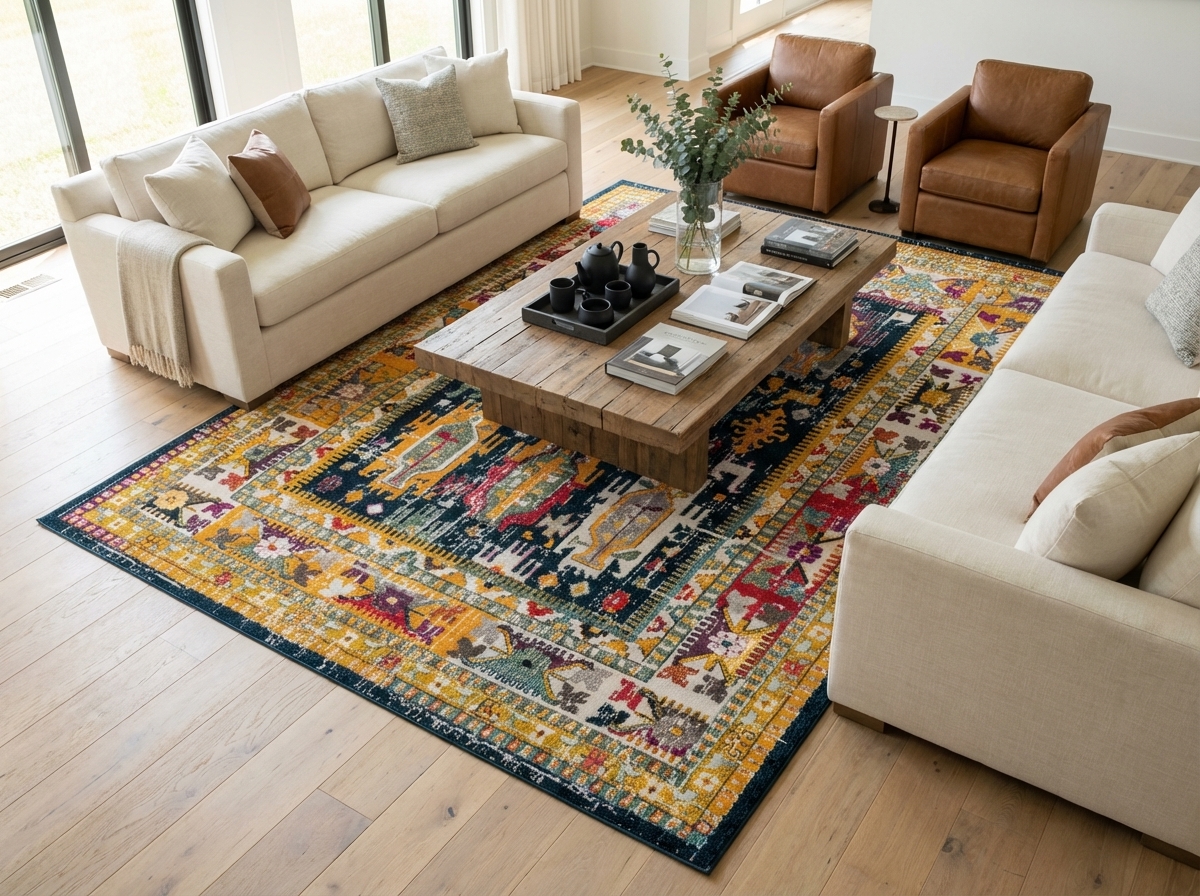
Have you ever noticed that when guests enter your home, they tend to sit in very specific spots – often the same ones every time?
It might feel random, but it’s not.
One of the biggest invisible factors guiding where people sit isn’t your furniture – it’s your rug.
Rugs quietly shape how people move through a space, where they feel comfortable, and even where conversations happen. Here’s how.
The Invisible Psychology Behind Seating Choices
When people enter a room, they quickly (and subconsciously) scan for cues:
- Where is the “main” area?
- Where do I belong?
- Where is it comfortable to sit?
They rarely think about it consciously, but their brain is looking for structure and boundaries.
This is where rugs come in.
A rug creates a visual zone, signaling:
“This is where activity happens.”
Without a rug, a room can feel open – but also unclear.
Rugs Create “Permission” to Sit
A rug doesn’t just define space – it gives people permission.
When seating is placed on or around a rug, it tells guests:
- This is a conversation area
- This is where you can relax
- This is the “center” of the room
Without that anchor, people may:
- Hesitate before sitting
- Choose seats farther away
- Default to edges of the room
Why People Avoid “Floating” Seating Areas
If your furniture isn’t anchored by a rug, guests may feel subtly uncomfortable.
Even if they don’t know why.
That’s because:
- The seating feels disconnected
- There’s no clear boundary
- The space lacks definition
The result: People often choose chairs against walls or “safer” spots instead of central seating.
Rugs Pull People Into Conversation Zones
A well-placed rug naturally draws people inward.
Here’s how it works:
- A rug visually groups furniture together
- Grouped furniture signals interaction
- Guests gravitate toward those groupings
It’s why living rooms with properly sized rugs feel:
- More social
- More inviting
- Easier to navigate
The Size of Your Rug Changes Behavior
Rug size has a surprisingly big impact on how people use your space.
Too Small:
- Furniture feels disconnected
- Guests sit on the edges of the room
- Conversation feels scattered
Properly Sized:
- Seating feels intentional
- Guests gather naturally
- The room feels cohesive
If people avoid your main seating area, your rug may be too small – or missing entirely.
Rugs Influence “Best Seat” Hierarchy
Every room has a “best seat” – the one people gravitate toward first.
Rugs help define that hierarchy.
Example:
- The seat fully on the rug → feels like the primary spot
- A chair partially off → feels secondary
- Seating outside the rug → feels disconnected
Without realizing it, guests often choose the seat most connected to the rug
Open Floor Plans: Where Rugs Matter Even More
In open layouts, there are no walls to define spaces.
So what replaces them?
Rugs.
Without rugs:
- Guests may feel unsure where to sit
- Spaces blend together
- Seating feels temporary or undefined
With rugs:
- Each area has a clear purpose
- Guests instinctively understand the layout
- Movement through the room feels natural
Rugs Affect How Long Guests Stay
Comfort isn’t just physical – it’s psychological.
When a space feels:
- Defined
- Balanced
- Grounded
People are more likely to:
- Sit longer
- Relax more deeply
- Engage in conversation
A rug contributes to all of this by creating a sense of stability and belonging.
Common Rug Mistakes That Confuse Guests
If guests don’t seem to use your seating area as expected, one of these could be the reason:
No rug at all
Makes the space feel undefined
Rug is too small
Doesn’t connect furniture
Furniture completely off the rug
Breaks the visual grouping
Rug placed incorrectly
Creates awkward or unclear zones
How to Use Rugs to Guide Seating (Intentionally)
Want to subtly guide where guests sit?
Do this:
- Use a rug large enough to anchor your main seating
- Place at least the front legs of furniture on the rug
- Center your layout around the rug—not the walls
- Keep seating close enough to feel connected
Think of the rug as the “stage” – and furniture as the actors.
The Subtle Power of Rugs
Rugs are often seen as decorative – but they’re much more than that.
They:
- Shape behavior
- Guide movement
- Influence comfort
- Define social interaction
All without anyone consciously noticing.
Final Thoughts
If your guests:
- Sit in unexpected places
- Avoid the main seating area
- Or your room just doesn’t feel quite right
The issue might not be your furniture.
It might be your rug – or lack of one.
Key Takeaways
- Rugs create invisible boundaries that guide seating behavior
- Guests naturally gravitate toward rug-defined areas
- Rug size and placement directly affect how a room is used
- Properly anchored furniture creates more inviting spaces
- Rugs influence both comfort and social interaction
Next time you have guests over, pay attention to where they sit.
You might realize your rug made the decision for them.
About Rugs.comRugs.com is a one-stop online rug shop for all your floor covering needs. With over 100,000 rug designs, the extensive selection of indoor and outdoor rugs offers a wide variety of shapes, styles, and textures – perfect for every season of the year and season of life. With more than 60 years of experience in hand-knotted and machine-woven rugs, the family-owned and operated business believes that “Beneath Every Moment” – whether it is a baby’s first step, a first dance, or a cherished memory – there should be a beautiful rug. Helping shoppers find the perfect foundation for life’s moments, Rugs.com is making online shopping simple with the lowest possible prices, fast and free shipping every day, award-winning customer support, and a 30-day free return policy. Rugs.com ships millions of rugs nationwide from the company’s South Carolina and California warehouses. Learn more at www.rugs.com.