
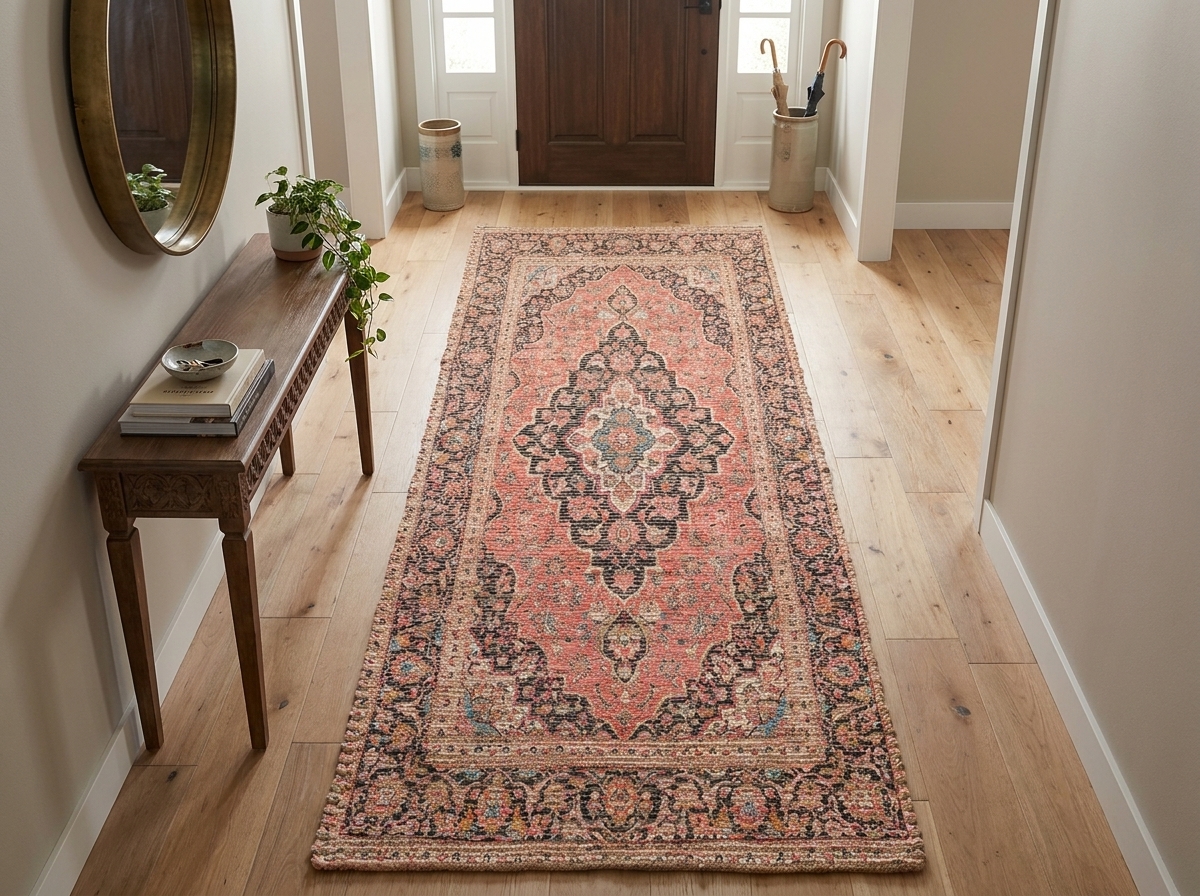
Traditional style has never really gone away. Trends come and go, but a well-chosen traditional rug still anchors more living rooms, dining rooms, and entryways than almost any other style on the market. It reads as established, collected, and a little bit timeless, the kind of piece that looks just as good in a hundred-year-old house as it does in a new build.
At the heart of traditional design is the rug. More than any other element in a room, a traditional rug carries the pattern, the color story, and the sense of history that the whole space is built around.
Here’s how to choose, place, and style a traditional rug so your room feels refined instead of dated.
What Makes a Rug “Traditional”
Traditional rugs draw from centuries-old weaving traditions, mainly Persian, Turkish, and other Middle Eastern and Central Asian textile cultures, along with European interpretations like Aubusson and Savonnerie. A few traits show up again and again:
- Intricate, symmetrical patterns – medallions, florals, vines, and botanical motifs arranged in structured, often repeating layouts
- Rich, saturated colors – deep reds, navy, gold, forest green, and ivory are the traditional palette’s backbone
- Dense, detailed weaves – traditional rugs are usually more intricate and higher-knot-count than casual or contemporary styles
- Border-heavy design – most traditional rugs have one or more decorative borders framing a central field, unlike the borderless look common in modern rugs
- A sense of formality – even a worn or distressed traditional rug tends to read as elegant rather than casual
If a rug looks like it belongs in a historic home, a library, or a formal dining room, it’s almost certainly traditional.
The Most Popular Traditional Rug Styles
A handful of specific rug types define the traditional category. Any one of them can be the starting point for a room.
Persian rugs – The foundation of traditional style. Regional styles like Tabriz, Kashan, and Isfahan each have their own motifs, but all share fine detail and rich, layered color.
Oriental rugs – A broader category covering hand-knotted rugs from across Asia and the Middle East, often used interchangeably with “Persian” but technically wider in origin.
Oushak rugs – Turkish rugs known for softer, more muted colors and larger-scale patterns than classic Persian designs. A popular bridge between traditional and transitional style.
Heriz and Serapi rugs – Bold, large-medallion Persian rugs in brick red, rust, and navy. They tend to read as slightly more rustic and masculine than finer Persian weaves.
Aubusson and French rugs – Flat-woven, floral, and pastel-toned. These bring a softer, more feminine traditional look and work especially well in formal living rooms and bedrooms.
Bokhara rugs – Recognizable by their repeating oval or octagonal medallions, usually in deep red with black and ivory accents.
How to Choose a Traditional Rug for Your Space
Traditional rugs are forgiving in some ways and demanding in others. A few decisions matter more than the rest.
Let the room’s undertone guide the rug’s palette. Warm wood floors and furniture pair naturally with reds, golds, and rust. Cooler-toned rooms lean better toward navy, forest green, and ivory. Pulling one color directly from your rug into pillows, drapery, or art ties the whole room together.
Match the density of the pattern to the room. A highly detailed, busy rug works beautifully as the star of a simpler room. If your furniture, art, and drapery are already pattern-heavy, choose a traditional rug with a calmer, more open field and let the border carry the detail.
Consider scale carefully. Traditional patterns can visually shrink a room if the rug is too small for the space. Err on the larger side, and make sure the medallion or central motif is actually large enough to read clearly rather than looking cramped.
Don’t dismiss traditional as “formal only.” A worn Persian or a muted Oushak can feel just as at home in a casual living room as it does in a dining room, especially when paired with simpler, more contemporary furniture.
Mixing Traditional Rugs with Modern Rooms
One of the biggest shifts in how people use traditional rugs is pairing them with decidedly non-traditional furniture. This “old meets new” approach, sometimes called modern traditional or grandmillennial style, is one of the most popular looks in interior design right now.
A few ways to make the mix work:
Pair an ornate rug with clean-lined furniture. A Persian or Oushak rug under a simple mid-century sofa or minimalist dining table lets the rug’s detail stand out instead of competing with other ornate pieces.
Use a faded or muted traditional rug for a more casual pairing. Vintage-style Oushaks and distressed Persians read as lived-in and relaxed, making them easier to mix into an otherwise contemporary room.
Let the rug be the only pattern in the room. When mixing styles, simplicity elsewhere – solid sofas, plain drapery, minimal art – keeps a detailed traditional rug from fighting with the rest of the space.
Room-by-Room Traditional Rug Styling
Living Room
A traditional rug is often the single most defining choice in a living room. Choose a size that lets the front legs of your sofa and chairs sit on the rug, with 8 to 12 inches of rug showing past the furniture. A large central medallion design works well in open layouts, while an all-over pattern is more forgiving in smaller or oddly shaped rooms.
Dining Room
Dense, finely woven traditional rugs hold up well under dining chairs and are easier to keep looking sharp than looser weaves. Follow the standard rule of 24 inches of rug extending past all sides of the table, so chairs stay on the rug even when pulled out.
Bedroom
A traditional rug in the bedroom adds warmth and softness underfoot. Place it under the lower two-thirds of the bed, extending past the foot and sides. Softer-toned Aubusson or Oushak styles tend to feel more restful in a bedroom than a bold, high-contrast Heriz.
Entryway and Hallway
Entryways are one of the best places to use a traditional rug, including a smaller or more worn piece you couldn’t build a whole room around. A runner in a Heriz or Bokhara pattern brings warmth and color to a hallway and hides wear better than a plain or lightly patterned alternative.
Colors and Patterns That Work Especially Well
If you’re building a room around a traditional rug and want a reliable starting palette, these combinations consistently work:
Red, navy, and gold – the classic Persian palette. Warm, formal, and timeless.
Rust, ivory, and brick – the Heriz and Serapi look. Bolder and slightly more rustic.
Blush, sage, and cream – an Aubusson-inspired palette that softens traditional style for bedrooms and living rooms.
Deep green, burgundy, and ivory – a richer, more library-like traditional palette that pairs beautifully with dark wood.
The Bottom Line
A traditional rug brings a sense of history and craftsmanship that’s hard to replicate with any other style. The best traditional rooms don’t treat the rug as background, they let it lead, and build the rest of the space around its color and pattern. Whether you’re furnishing a formal dining room or looking for one grounding piece in an otherwise modern home, a well-chosen traditional rug still does the job better than almost anything else.
Traditional doesn’t have to mean dated. Choose a rug with genuine detail and good color, and the room will feel timeless instead of stuck in the past.
About Rugs.com
Rugs.com is a one-stop online rug shop for all your floor covering needs. With over 100,000 rug designs, the extensive selection of indoor and outdoor rugs offers a wide variety of shapes, styles, and textures – perfect for every season of the year and season of life. With more than 60 years of experience in hand-knotted and machine-woven rugs, the family-owned and operated business believes that “Beneath Every Moment” – whether it is a baby’s first step, a first dance, or a cherished memory – there should be a beautiful rug. Helping shoppers find the perfect foundation for life’s moments, Rugs.com is making online shopping simple with the lowest possible prices, fast and free shipping every day, award-winning customer support, and a 30-day free return policy. Rugs.com ships millions of rugs nationwide from the company’s South Carolina and California warehouses. Learn more at www.rugs.com.