
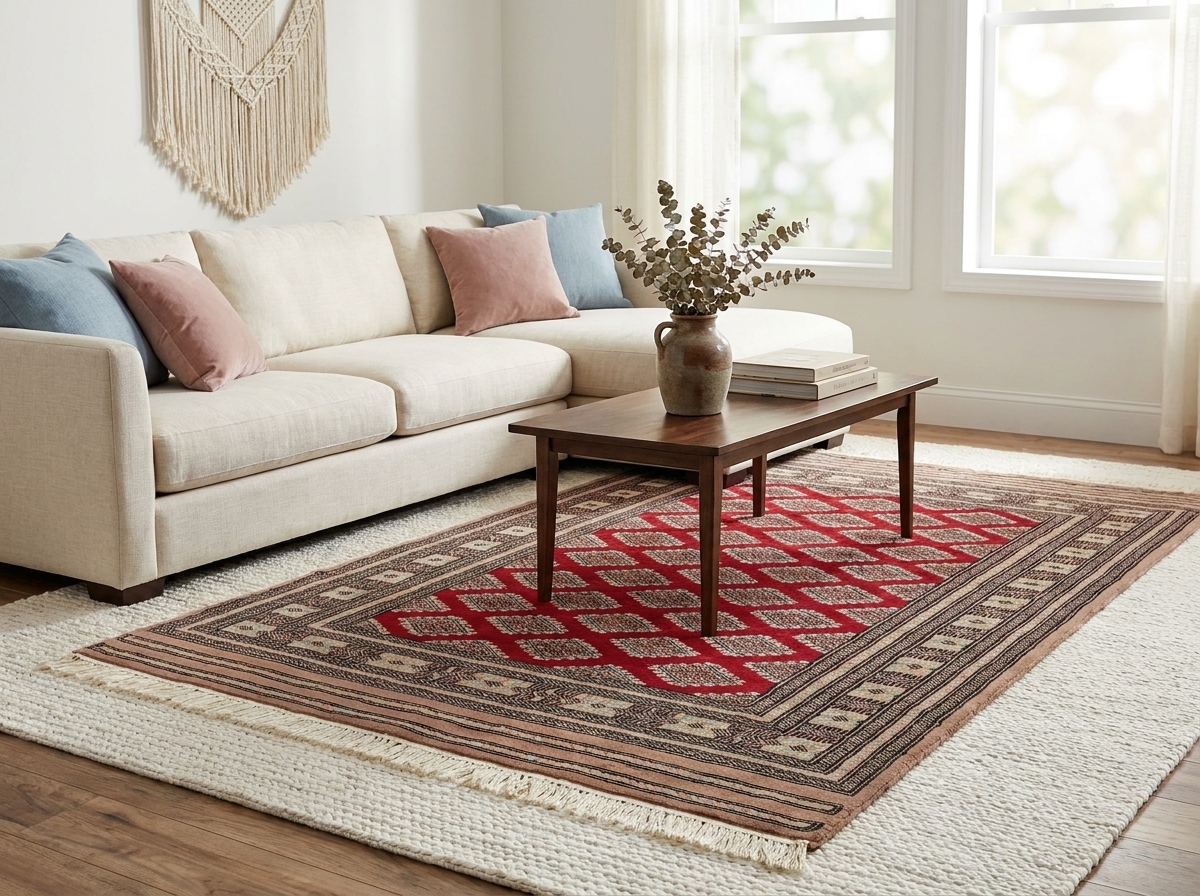
Layered rugs are one of the most talked-about design moves of the last decade, and one of the most misunderstood. Done well, layering adds depth, warmth, texture, and personality to a room in a way a single rug can’t. Done badly, it looks like you couldn’t decide.
The good news: there are really only a few decisions that separate a beautiful layered look from an accidental one. Once you understand what makes layering work, you can pull it off in almost any room and any style – boho, modern, farmhouse, traditional, or anything in between.
Here’s how.
Why Layer Rugs at All
Before we get into the how, it helps to know the why. Layering rugs solves specific problems that a single rug can’t:
- A small rug feels lost. Layering it over a larger neutral rug gives it a proper frame and makes both pieces feel intentional.
- A big rug feels flat. Adding a smaller patterned rug on top creates depth and a focal point.
- A room feels cold. Layering adds visual and physical warmth – an extra pile height, an extra texture, an extra layer of insulation from a hard floor.
- You have a rug you love but it doesn’t fit. Layering lets you use a beautiful piece that’s too small for the space on its own.
- A neutral room needs a hit of pattern. Layering lets you add pattern without committing to a large patterned rug.
If none of those describe your room, you may not need to layer at all. A single well-sized rug is often the right answer. Layering is a tool, not a requirement.
The Two Rugs: What Goes on the Bottom, What Goes on Top
Most successful layered looks follow the same basic structure: a large, quiet base rug on the bottom, and a smaller, more interesting rug on top.
The base rug is the anchor. It should be sized for the room the way any single rug would be – big enough that the furniture arrangement sits properly on it (or in front of it). Its job is to ground the space and provide a neutral canvas for the top rug to shine against.
The top rug is the star. It’s the one with the color, pattern, or texture you want to draw the eye to. It’s smaller than the base rug, and it should feel like it was chosen with intention – not like it just happens to be sitting on top of something else.
Get those two roles right and layering becomes almost foolproof.
The Best Base Rugs for Layering
The base rug’s job is to be quietly great. It should add texture and warmth without competing with the top rug for attention.
The most reliable base rugs:
Textured jute. Natural fiber rugs are the most popular base rug choice for a reason. They add texture, they read as neutral, and they play well with almost any style – boho, modern, farmhouse, coastal, traditional.
Large flatweaves in solid or subtle tones. Cream, oatmeal, warm gray, or taupe flatweaves work as bases in modern and Scandinavian rooms.
Low-pile wool in a solid color. More expensive than jute but softer underfoot and warmer in feel. A great choice for bedrooms and living rooms where comfort matters.
Cotton flatweaves. Lightweight, washable, and inexpensive. A good starter option for renters or anyone experimenting with the look.
What to avoid as a base: anything highly patterned, anything with a lot of pile height, and anything with a strong color. The base rug should recede so the top rug can lead.
The Best Top Rugs for Layering
The top rug is where you get to have fun. This is the piece you fell in love with in a shop or online – the vintage runner, the small Moroccan, the bold kilim.
The most successful top rugs:
Vintage and vintage-style rugs. Faded Persians, Turkish rugs, and reproductions of both. The soft colors and intricate patterns look beautiful against a plain jute or flatweave base.
Moroccan rugs. Beni Ourain, Boucherouite, and other Moroccan styles are almost purpose-built for layering. They add pattern and warmth without overpowering the room.
Kilims and flatweaves with bold pattern. A patterned kilim over a jute base is one of the most reliable layered looks in interior design. Works in almost any style.
Small shag or high-pile rugs. For adding textural contrast rather than pattern contrast. A cream shag over a flat jute is a classic modern move.
Sheepskin or hide rugs. More of an accent than a full second layer, but they work beautifully draped over a larger neutral rug in front of a fireplace or reading chair.
Sizing: How to Get the Proportions Right
The single most common layering mistake is bad proportion. Get this wrong and no amount of styling will save it.
The base rug should be large enough that a substantial border of it shows around the top rug on all sides – usually 12 to 24 inches of base rug visible around the edges of the top rug. Any less and the layering doesn’t read; any more and the top rug looks like it’s floating.
The top rug should be centered on the base rug and positioned so it makes sense with the furniture. In a living room, the top rug usually sits under the coffee table with all seating around it. In a bedroom, the top rug often sits at the foot of the bed or as a runner alongside it.
A quick sanity check: if you can’t tell that the top rug is a deliberate layered choice – if it just looks like a small rug on top of a bigger rug by accident – the top rug is probably too small, or the base rug is too big, or the alignment is off.
Layering by Room
Living Room
The most common place to layer, and the easiest to get right. Start with a jute or sisal rug sized so all your furniture legs sit on it (or at least the front legs). Then layer a smaller patterned rug on top, centered under the coffee table.
The top rug should be big enough that it visibly extends past the edges of the coffee table on all sides – not just a small square peeking out from underneath. A 5′ x 8′ or 6′ x 9′ top rug over an 8′ x 10′ or 9′ x 12′ base rug is a common combination.
Bedroom
Two layering approaches work especially well in bedrooms.
Base rug plus runners. A large neutral rug under the bed, with two smaller runners layered on top on either side. This adds pattern and warmth exactly where your feet land in the morning.
Base rug plus a top rug at the foot. A large neutral rug under the bed, with a smaller patterned rug layered at the foot of the bed, extending into the room. Great for adding a color moment at the far end of the room.
Dining Room
Layering in a dining room is trickier because chairs need to slide smoothly. A large flatweave base with a smaller flatweave top works if you commit to low pile all the way through. Skip layering entirely in the dining room if you have long-pile rugs or heavy chairs – the friction and unevenness will drive you crazy.
Entryway
A small entryway is a great place to try layering with lower stakes. A jute rug under a smaller patterned runner or accent rug in front of the door adds pattern and texture without committing to a big layered moment in a main room.
The One Practical Problem: Slipping
The single biggest frustration people have with layered rugs is that the top rug won’t stay put. It bunches, slides, and shifts every time someone walks across it.
The fix is a rug pad – but specifically a rug-on-rug pad, not the standard rug-on-floor pad you’d use under a single rug. Rug-on-rug pads have a grippy top surface designed to hold onto the base rug’s fibers, plus a grippy bottom surface for the base rug. They’re inexpensive, and they solve the problem completely.
If you don’t want to buy a specialty pad, a strip of rug tape along the edges of the top rug works as a quick fix – but a proper rug pad is the better long-term solution.
Common Layering Mistakes to Avoid
Two patterned rugs that fight. If both rugs have big, busy patterns, the effect is chaos. Keep either the top or the bottom quiet.
Colors from completely different palettes. A cool blue Persian rug over a warm terracotta jute will look accidental. Share at least one color family between the two rugs.
Top rug too small. If the top rug looks like an afterthought, it is one. Size up.
Top rug too big. If only a thin sliver of the base rug shows, you’ve essentially just bought two rugs to look like one. Size the top rug down.
Bad centering. A top rug that’s off-center on the base rug looks like a mistake even when everything else is right. Take the time to center it properly.
Layering for the sake of layering. If your room already has a well-sized, beautiful rug and doesn’t feel cold or flat, adding a second rug is just clutter. Layering solves problems – it doesn’t create style on its own.
The Bottom Line
Layering rugs works when it looks intentional. A quiet base rug that adds texture, a smaller top rug that adds color or pattern, the right proportions, and a rug pad to keep everything in place – those are the four decisions that separate a beautiful layered look from a messy one.
Layering isn’t a shortcut and it isn’t a trend. It’s a design tool that solves specific problems: cold rooms, small rugs, flat spaces, missing pattern. Use it when you need it, skip it when you don’t, and pay attention to the proportions when you do.
A layered rug done right doesn’t look layered by accident. It looks like the room was always meant to have exactly those two pieces, exactly there.
About Rugs.comRugs.com is a one-stop online rug shop for all your floor covering needs. With over 100,000 rug designs, the extensive selection of indoor and outdoor rugs offers a wide variety of shapes, styles, and textures – perfect for every season of the year and season of life. With more than 60 years of experience in hand-knotted and machine-woven rugs, the family-owned and operated business believes that “Beneath Every Moment” – whether it is a baby’s first step, a first dance, or a cherished memory – there should be a beautiful rug. Helping shoppers find the perfect foundation for life’s moments, Rugs.com is making online shopping simple with the lowest possible prices, fast and free shipping every day, award-winning customer support, and a 30-day free return policy. Rugs.com ships millions of rugs nationwide from the company’s South Carolina and California warehouses. Learn more at www.rugs.com.